_edited.png)
What Is Inside a Premium Developmental Editing Package? Scope and Deliverables
- Holly Totten
- Jul 16
- 13 min read

You have decided to invest in a developmental edit. You have done the research, compared rates, asked the right questions. And now, the question that sits underneath all of that due diligence: what exactly arrives in your inbox when the edit is done?

This is not a small question. A developmental edit for a 60,000-word nonfiction manuscript costs between $2,400 and $3,000 at current professional rates. That investment deserves complete clarity on what it produces. Too many authors enter this process with only a vague sense of "feedback" as the output, then feel uncertain when the actual deliverables arrive about whether they have received what they paid for.
This post removes that ambiguity entirely. Every component of a premium developmental editing package is explained in specific detail below: what it looks like, what a high-quality version delivers, how to recognize a thorough example from a superficial one, and what you do with each piece. By the time you finish reading, you will know exactly what to expect, how to evaluate what you receive, and what questions to ask before you sign.
For a broader overview of what developmental editing services actually cover from a conceptual standpoint, that post builds the foundation this one builds on.
What a Premium Developmental Editing Package Includes
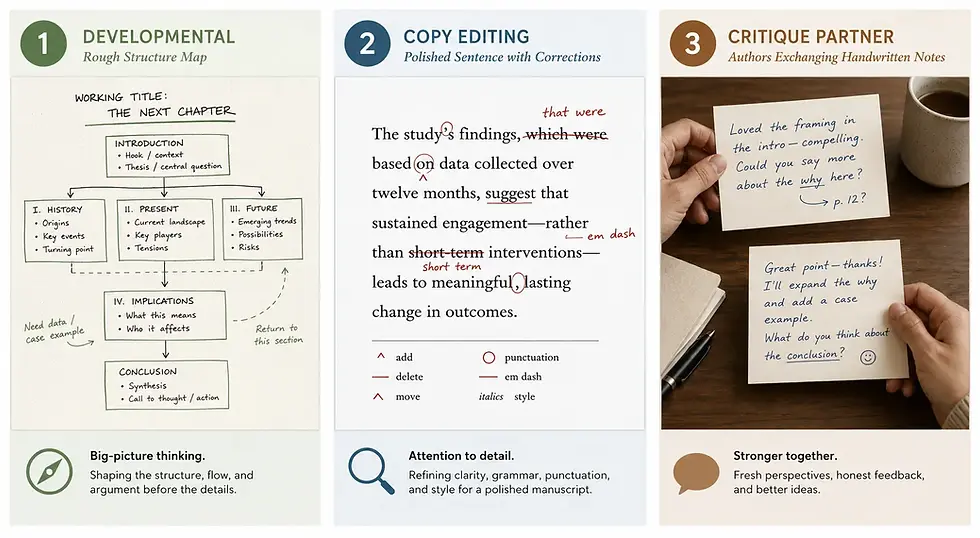
A professional developmental editing package is not a single document. It is a coordinated set of deliverables designed to give you both the big-picture analysis and the page-level evidence you need to revise your manuscript effectively.
According to The Independent Publishing Magazine's comprehensive 2026 guide to developmental editing deliverables, a professional developmental edit typically includes: a detailed editorial letter, in-manuscript margin comments on the full manuscript, a book map or revised table of contents, a debrief call, and a follow-up Q and A window. The quality signal is not the length of any individual deliverable but whether you can execute a meaningful revision without guesswork afterward.
Here is what each component delivers and what distinguishes the premium version from the adequate one.
Deliverable | What It Is | What Premium Looks Like |
Editorial Letter | Big-picture analysis of the manuscript's strengths and structural issues | 8 to 20 pages, prioritized, with specific examples from your text |
Manuscript Margin Comments | Chapter-by-chapter notes directly on your pages | Structural reasoning tied to reader experience, not grammar corrections |
Book Map or TOC Revision | A visual or structured overview of your manuscript's architecture | Chapter-level breakdown showing purpose, flow, and gaps |
Debrief Call | A live conversation to walk through the editorial letter | 45 to 60 minutes; structured around your priority revision questions |
Q and A Window | Post-debrief access to ask follow-up questions | Defined window, typically one to two weeks; email or scheduled call |
The Editorial Letter: Your Structural Blueprint
The editorial letter is the centerpiece of any developmental editing package. It is a detailed, structured document, typically between 8 and 20 pages for a full-length nonfiction manuscript, that provides a comprehensive diagnosis of your book: what is working, what is not, and a prioritized roadmap for your next draft.

A strong editorial letter does several things that a superficial one does not.
It is organized by priority, not by chapter: The best editorial letters front-load the most significant issues. If your book's central argument is unclear, that is addressed first, before discussion of pacing or chapter transitions. This prioritization tells you where to invest your revision energy for maximum impact.
It explains causes, not just symptoms: A weak editorial letter identifies problems. A strong one tells you exactly why each problem exists and how it affects the reader experience. "Chapter seven feels slow" is a symptom. "Chapter seven revisits material already established in chapter four, which creates repetition that signals to the reader that the argument is not advancing" is a diagnosis with a clear revision path attached.
It is grounded in specific examples from your manuscript: Every observation should be supported by a reference to specific pages, passages, or chapter moments in your book. General observations without manuscript evidence are the hallmark of a superficial editorial pass. When your letter says "the argument in chapter nine does not connect to the book's central premise," it should tell you which specific passage and why.
It asks generative questions alongside its recommendations: According to Reedsy's complete guide to developmental editing, strong editorial letters pose questions that help the author think through key decisions themselves rather than simply telling the author what to do. This approach produces better revisions because the author retains genuine creative agency over the solution, even when the problem has been clearly named.
It ends with a prioritized revision list: The most useful editorial letters conclude with a clear ranking of revision priorities: what must be addressed for the book to work, what should be addressed to strengthen it, and what could be addressed if time and scope allow. This ranking makes the revision process concrete rather than overwhelming.
What should a developmental editing package's editorial letter include?
A premium editorial letter for a nonfiction manuscript typically runs 8 to 20 pages and covers: an overview of the manuscript's central strengths, a prioritized list of structural concerns with specific examples from the text, an explanation of how each issue affects the reader experience, recommended revision approaches for each identified problem, and a concluding priority ranking (must address, should address, could address). It should be organized by importance rather than chapter order, grounded in specific passages from your manuscript, and written with enough detail that you can execute meaningful revision without follow-up questions. A letter that reads as generic advice rather than analysis of your specific manuscript is a signal of superficial engagement.
In-Line Manuscript Comments and Margin Notes
The editorial letter provides the view from 30,000 feet. The margin notes bring that analysis down to the page level.

In a premium developmental editing package, your manuscript is returned to you with comments inserted directly into the text at the specific moments where each structural issue manifests. These margin notes serve as the bridge between the editorial letter's diagnosis and the actual pages that need attention.
There is an important distinction between what margin notes in a developmental edit look like and what they look like in a copy edit. Developmental margin notes are structural in nature: they flag where an argument loses the reader, where a chapter fails to advance the book's thesis, where a transition between ideas is unclear, or where an example contradicts an earlier claim. They do not correct grammar, rewrite sentences, or adjust punctuation.
What you are looking for in developmental margin notes is this: each comment should explain the editor's thinking, not just identify a problem. "This section feels repetitive" is a weak margin note. "This paragraph restates the point made on page 43 without advancing it. The reader is being held at the same level of understanding rather than being moved forward. Consider cutting and linking directly to your next new claim" is a margin note with genuine developmental value.
BubbleCow's comprehensive guide to what a developmental edit looks like from inside the process identifies comment density as a quality signal: editors who leave substantive, reasoning-based comments across the full manuscript are providing deeper structural engagement than those who comment only in the most obviously problematic sections.
A premium package includes margin comments on the full manuscript, not just selected chapters. Partial annotation is acceptable in a manuscript assessment or an editorial assessment (a lighter alternative), but a full developmental edit should cover the entire text.
How many margin comments should I expect from a developmental editor?
The number of margin comments varies by manuscript length, structural complexity, and the editor's working style. What matters more than volume is specificity and reasoning. A strong developmental edit might leave 200 to 400 comments across a 60,000-word manuscript, but each one should be specific to the structural issue it identifies and include a brief explanation of why the editor is flagging it. Fewer comments with deeper reasoning are more valuable than many comments that observe problems without explanation. If you receive margin comments that focus primarily on grammar and sentence-level corrections, the editor is functioning as a copyeditor, not a developmental editor, and the deliverable does not match the service you paid for.
The Book Map and Structural Overview
Beyond the editorial letter and margin comments, a premium developmental editing package often includes a book map or revised table of contents overview. This is a structured document, sometimes formatted as a spreadsheet or outline, that captures the architecture of your entire manuscript from the editor's perspective.
For a nonfiction book, a book map typically tracks: each chapter's stated purpose, whether the chapter delivers on that purpose, how each chapter connects to the book's central argument, and where transitions between chapters succeed or break down. It makes the manuscript's structural logic visible in a way that is difficult to perceive from within the manuscript itself.
This deliverable is particularly valuable for authors whose books have complex structures or who are struggling to see how their chapters relate to each other as a system rather than as individual pieces. Seeing your book mapped out objectively by an experienced editor often makes revision priorities immediately obvious in a way that no amount of self-re-reading does.
Not every developmental editing package includes a formal book map. Ask for this deliverable specifically if it matters to your revision process. If an editor cannot describe what their structural overview looks like in concrete terms, that is useful information about the depth of their analytical process.
Ready to see exactly what a premium developmental editing package looks like for your nonfiction manuscript? Holly's editing services are built specifically for nonfiction authors. Every engagement includes the editorial letter, full manuscript annotation, a debrief call, and follow-up support. No vague promises. No mystery deliverables. View Holly's Editing Packages
The Debrief Call: Where the Edit Becomes a Plan
The debrief call is your opportunity to ask those questions directly, clarify the editor's reasoning on specific points, and build a concrete revision plan before you sit down to do the work.
A premium debrief call runs 45 to 60 minutes and is structured around your questions and revision priorities rather than a summary of the editorial letter. By the time you get on the call, you should have already read the letter and marked the points you want to discuss. The most valuable debrief conversations focus on the structural changes that feel most uncertain or most significant: how to approach a major chapter restructure, how to resolve conflicting feedback between the letter and your own instincts, or how to prioritize when everything feels like it needs revision at once.
A debrief call is not a sales conversation. It is part of the editing engagement. If an editor positions the debrief as optional or charges additionally for what should be a standard part of the package, clarify this before signing.

Will Your Editor Rewrite Your Manuscript?
No. A developmental editor does not rewrite your manuscript. Ghostwriting and developmental editing are different services with different purposes and different rate structures. The developmental editor's job is to identify what needs to change and explain specifically why, in enough detail that you can execute the revision yourself with genuine understanding of what you are trying to accomplish.
This distinction matters for two reasons. The first is creative: a book that has been substantially rewritten by someone else is no longer fully yours. The second is practical: if an editor makes major revisions to your pages rather than giving you the analytical tools to make them yourself, you will face the same structural problems in your next book because you never developed the understanding to avoid them.
Jane Friedman's comprehensive guide on what to know before hiring a developmental editor is clear on this: the editorial relationship works best when the author retains creative agency over the solution. The editor names the problem and proposes a direction. The execution is yours.
Some editors do make small suggested rewrites in the margin to illustrate a recommended direction, particularly for sentence-level clarity issues that serve as examples. These are illustrative, not prescriptive. You are always free to implement the underlying structural suggestion in your own language rather than adopting the editor's phrasing.
What a Premium Developmental Editing Package Costs at This Level of Scope
The investment for a premium developmental editing package, including the editorial letter, full manuscript annotation, book map, debrief call, and follow-up window, sits at the higher end of the professional rate range. At EFA rate chart benchmarks for nonfiction, expect 4 to 5 cents per word at standard turnaround, placing a 60,000-word manuscript at $2,400 to $3,000 and a longer 80,000-word manuscript at $3,200 to $4,000.
What separates a premium package from a mid-range one is not always rate. It is scope clarity and follow-up depth. An editor quoting $1,800 for a 60,000-word developmental edit may be offering a manuscript assessment with a letter only and no margin notes. An editor quoting $3,200 for the same manuscript with all five deliverables and a structured debrief is offering something substantively different. Compare quotes by deliverable, not by rate alone.
For a full breakdown of how these rates compare across editing stages and manuscript lengths, the post on the real cost of editing a book in 2026 has the complete picture. And if you want to evaluate whether the investment is justified for your specific book and goals, the post on whether a developmental editor is worth the investment walks through the ROI analysis in full.

How to Know You Are Getting a Premium Developmental Editing Package
Before you sign any editorial agreement, these are the five questions that protect your investment.
Ask for deliverable specifics in writing: "I provide an editorial letter and manuscript comments" is not enough detail. Ask for letter length range, comment density description, whether a book map or structural overview is included, and what the debrief call covers.
Ask whether the full manuscript is annotated: A partial annotation package, where only certain chapters receive margin comments, is less comprehensive than full manuscript coverage. Know what you are buying before the edit begins.
Ask what follow-up support looks like after the debrief: Can you send questions by email after the call? For how long? Is a second-pass review of revised sections available, and at what cost?
Ask for a sample editorial letter or past client testimonials: The post on how to request a sample developmental edit walks through exactly how to evaluate what you receive in a sample and what strong editorial thinking looks like compared to superficial coverage.
Ask about the revision timeline and milestone expectations: A premium engagement does not end when you receive the deliverables. Know how long you have to revise, whether checkpoint support is available during revision, and when to expect the engagement to formally close.
How Holly Structures Her Developmental Editing Package
The editing packages at Writely Notable are built specifically for nonfiction authors: memoir writers, business and self-help authors, and collaborative nonfiction projects. Every full developmental editing engagement includes the editorial letter, full manuscript annotation throughout, a structured debrief call, and a defined follow-up window for revision questions.
What makes the Writely Notable approach different is context. Holly brings over 30 years of
English education and editorial experience to every manuscript, with a specific understanding of how nonfiction communicates authority, builds trust with readers, and translates subject-matter expertise into a book that a non-expert audience can follow and value.
The clients who have come through this process consistently describe two things in their feedback: clarity they did not have before about what their book needed, and confidence in the revision work they were about to do. Both outcomes are products of deliverables that explain their reasoning, not just name problems.

Premium Developmental Editing Package? Scope and Deliverables Frequently Asked Questions
How long does it take to complete a premium developmental editing package?
For a 60,000-word nonfiction manuscript, expect a turnaround of four to six weeks from the date the editor begins the read. Longer or more structurally complex manuscripts may take six to eight weeks. Most professional developmental editors book two to four months in advance, so plan your editing timeline well ahead of your target publication date. Rush turnaround is typically available at a premium of 25 to 50 percent above the standard rate.
What is the difference between a developmental editing package and a manuscript assessment?
A manuscript assessment delivers the editorial letter only, without full in-manuscript margin annotation. It provides the same big-picture structural analysis but without chapter-level evidence on your pages. Assessments are typically 40 to 60 percent of the cost of a full developmental editing package and work well for authors who want directional feedback at an early draft stage or who have a strong revision instinct and primarily need the structural diagnosis rather than page-level evidence. A full developmental editing package provides both the letter and the annotation, giving you structural direction and specific evidence simultaneously.
Can I ask for specific areas of focus in my developmental editing package?
Yes, and you should. The most productive developmental edits begin with the author identifying two or three specific structural concerns: whether a particular chapter is working, whether the book's argument builds logically, whether the pacing serves the reader in a specific section. Directing the editor's attention toward your own known concerns does not limit the scope of their analysis. It ensures that the feedback you receive is oriented toward the questions that actually matter to your revision. Include these questions in your submission brief before the edit begins.
What do I do after I receive my developmental editing package?
Read the editorial letter in full before returning to your manuscript. Make notes on your immediate reactions: which observations feel accurate, which feel surprising, which you want to push back on. Then schedule the debrief call while the feedback is fresh. After the call, build a revision plan using the editor's priority ranking as your starting structure: address the must-fix issues first, then the should-fix issues, then the could-fix issues if time and energy allow. Work through revisions before moving to any other editing stage. A manuscript that has not yet been revised in response to developmental feedback is not ready for line editing or copyediting.
Conclusion: On Premium Developmental Editing Package? Scope and Deliverables
A premium developmental editing package is not a document. It is a system: a structured set of deliverables designed to give you everything you need to take a draft that is not yet working and revise it into a manuscript that does.
The authors who get the most from this process are the ones who know what to expect before it begins, evaluate deliverables clearly when they arrive, and enter the revision phase with a concrete plan rather than a vague sense of "now I have to fix everything."
You now have the knowledge to hire with confidence, evaluate deliverables with precision, and make the most of every component of the package you receive.
The next step is choosing the right editor for your book. Holly's editing packages are designed for nonfiction authors who want this level of depth, transparency, and editorial rigor applied to their work.
See exactly what Holly's developmental editing packages include for nonfiction authors. Every engagement is scoped specifically to your manuscript, your goals, and your timeline. View the full details and take the next step toward a manuscript you are confident publishing. View Holly's Editing Packages
About the Author: Holly Totten
Holly Totten is a nonfiction writing coach and editor with over 30 years of experience in English education and the founder of Writely Notable and Gathered with Purpose. She has published three collaborative books and works one-on-one with nonfiction authors, memoir writers, and entrepreneurs to take their manuscripts from first draft through to publication-ready. Connect with Holly on LinkedIn or learn more on the About page.

Comments