_edited.png)
The Step-by-Step Guide to Getting a Free Sample Developmental Edit Before You Hire
- Holly Totten
- Jul 14
- 11 min read

A developmental editor will spend weeks inside your manuscript, provide feedback that shapes significant revision, and charge several thousand dollars for the service. That combination of intimacy, influence, and investment makes it one of the highest-stakes professional decisions you will make during the publishing process.
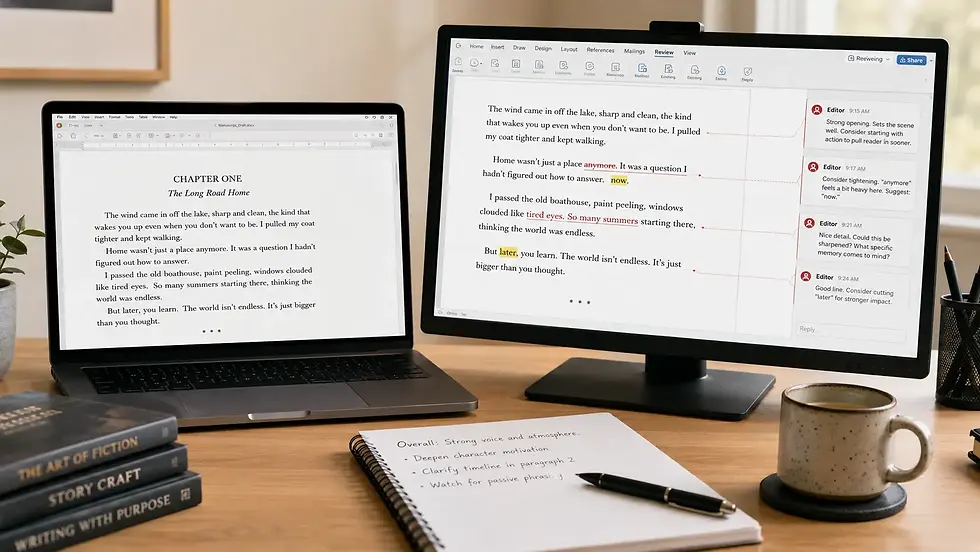
A sample developmental edit is the most effective tool available to protect that investment before you make it. It gives you concrete evidence of how an editor thinks, how their feedback lands on your specific pages, and whether their editorial instincts align with the story or argument you are trying to develop. It does all of this before you sign a contract or send a deposit.
This guide covers the full process: how to approach an editor for a sample edit with the right context and materials, exactly what to send and how to format it, how to read the feedback you receive with a clear evaluative eye, and what to do in the situations where a sample is not available.
If you are still at the stage of building your shortlist of editors to approach, the post on how to choose and vet a developmental editor covers that process first. This post assumes you have candidates in mind and you are ready to move from evaluation to a direct test of fit.
How to Pitch an Editor for a Sample Developmental Edit
Most established developmental editors offer sample edits, though some do not, for reasons explained later in this post. When you reach out to request one, the quality of your inquiry directly affects the quality of the response you get.
The Right Length to Send
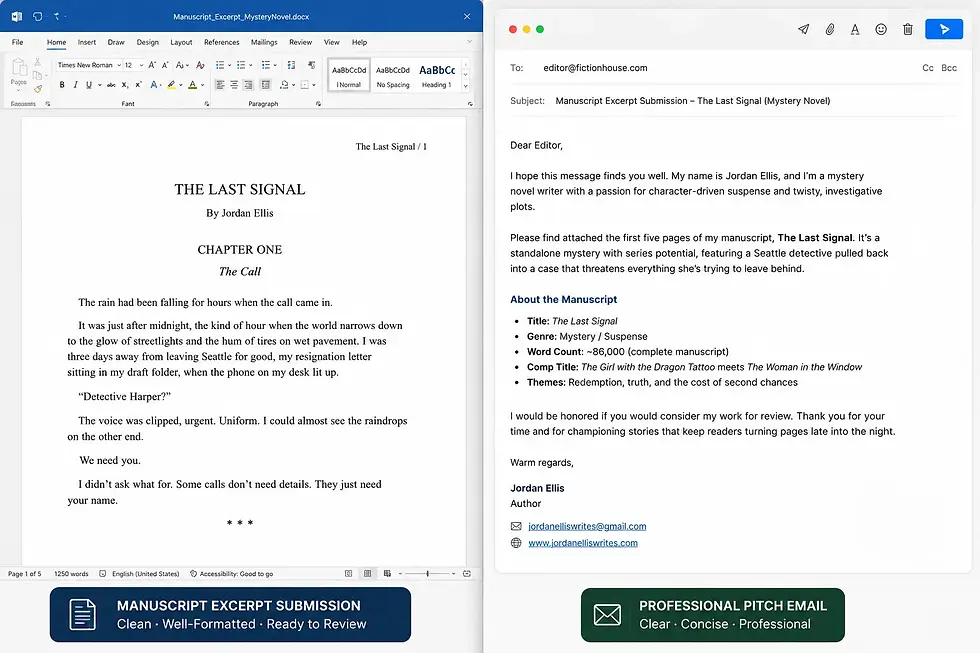
The standard expectation for a sample developmental edit is 1,000 to 1,500 words of your manuscript. Some editors accept up to 2,000 words. A few, like those operating on a formal intake system, specify exactly what they want in their submission guidelines. Always check the editor's website before sending anything.
Sending more than 2,000 words for a sample is generally not appropriate. You are asking the editor to demonstrate their skills, not to perform a substantial portion of the work for free. An editor who accepts an unusually long sample without comment may be establishing a pattern of unclear scope boundaries, which is worth noting.
Which Pages to Send
Where in your manuscript you pull the sample matters more than most authors realize. Many authors default to sending the opening pages, which makes intuitive sense but is often the wrong choice for a developmental sample.
Your opening pages are usually your most revised, most polished section. They may not represent the structural challenges present in the middle or later portions of your manuscript. A developmental editor evaluating only your opening pages gets a partial and often unrepresentative picture of what the full edit will require.
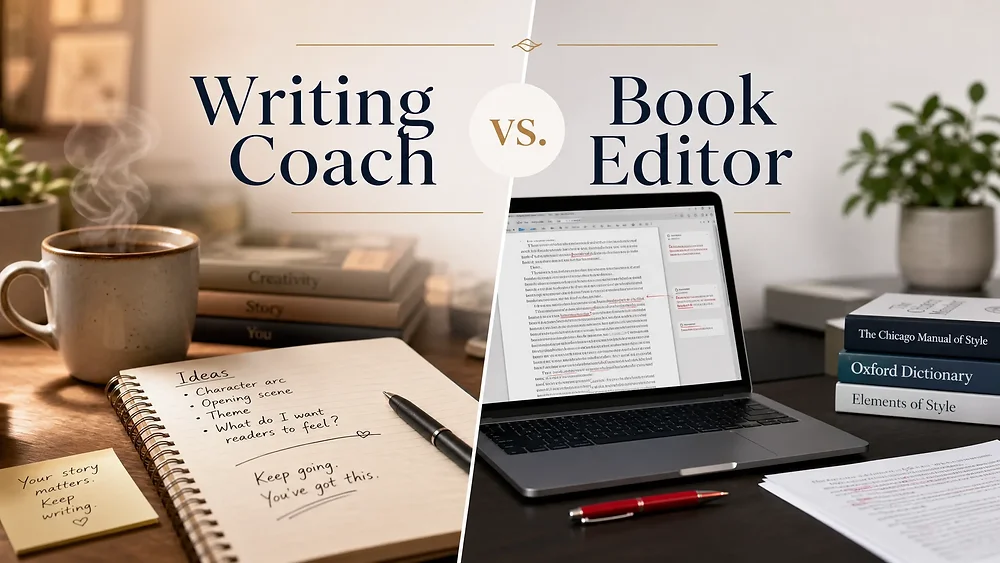
Send pages from the middle of your manuscript instead. A representative chapter or section from roughly the midpoint gives the editor a truer sense of how your structure, pacing, and argument develop across the whole book. For nonfiction, consider sending a chapter where you transition between a major concept or where your argument becomes more complex. This is where structural problems are most likely to appear, and it is where genuinely good developmental feedback is most revealing.
How to Format Your Submission
Standard professional formatting for manuscript submission applies to sample edit requests as well. Use a Word document (.docx format), double-spaced, with one-inch margins, in Times New Roman or Courier at 12-point size. Include your name, book title, and the page range in a header. Name the file clearly: BookTitle_v[version number]_[date].docx. Clear file naming signals professionalism and makes it easier for the editor to keep track of incoming materials.
What to Include Alongside the Pages
A bare submission of pages without context puts the editor at a disadvantage. Send a brief introductory note covering: your book's title and working genre or category, total word count and current draft stage, your target reader in one or two sentences, two or three specific questions you want the editor to focus on, and a note about your timeline and publishing goals.
Keep the note to one page. Specific questions focused on structure and argument are far more useful than general requests for feedback. Good example questions include: "Does my argument build logically between these chapters?" or "Is the pacing serving the reader in this section?" Avoid questions about grammar, sentence flow, or word choice. Those belong in a different editing stage and asking them signals to the developmental editor that you may not fully understand the scope of their service.
The EFA rate chart and real cost of editing overview are worth reviewing before you pitch, so you understand how the sample fits into the context of a full engagement and what rate range to expect in any quote that follows.
According to BubbleCow's guide to developmental editing submission standards, including a one-page synopsis alongside your sample is standard practice for longer projects. A synopsis helps the editor understand the full scope of the manuscript rather than evaluating your midpoint pages without any structural context.
What should I send when requesting a sample developmental edit?
Send 1,000 to 1,500 words from the middle of your manuscript, not the opening pages, because representative midpoint pages show your structure more accurately than your most-polished opening section. Format the excerpt in a Word document, double-spaced, in 12-point Times New Roman with one-inch margins, and name the file clearly with your book title, version, and date. Include a brief introductory note with your book's genre, word count, target reader, timeline, and two or three specific structural questions you want the editor to focus on. Add a one-page synopsis if the manuscript is full-length. Keep the note to one page.
How to Evaluate a Sample Developmental Edit
Receiving the sample feedback is the most important moment in the hiring process. How you read it determines whether the evaluation serves you.
What Strong Developmental Sample Feedback Looks Like
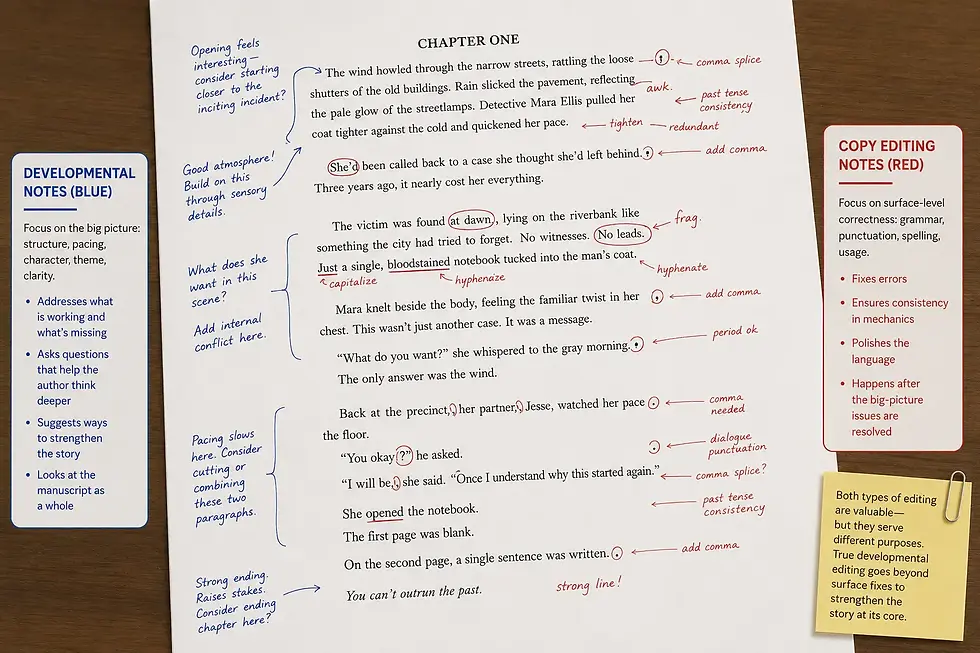
A genuinely good developmental sample edit does not look like a grammar lesson. The editor's comments should be engaging with the structural and argumentative work of your specific pages, not running corrections on sentence mechanics. Look for these qualities in the feedback you receive.
Specificity about structural issues: A strong sample comment identifies exactly what is not working and gives a reason that connects to the reader's experience or the manuscript's overall argument. "This section feels slow" is weak feedback. "This section covers ground already established in the previous chapter, which loses reader momentum and dilutes the argument you are building toward chapter five" is strong feedback. The difference is diagnosis with reasoning, not observation without direction.
Comments that explain the editor's thinking: According to the complete guide to sample edits by Olivia Helps Writers, even if a developmental sample cannot fully reflect what a whole-manuscript edit will cover, it clearly reveals the editor's communication style, the depth of their engagement, and whether their instincts align with what you are trying to accomplish. An editor who explains why they are flagging something tells you far more than one who lists problems without reasoning.
Respect for your voice and vision: Developmental feedback should help you write a better version of your book, not redirect your book toward a different one. If the feedback consistently pushes your argument in a direction that feels misaligned with your purpose, that is important information about fit, not necessarily a flaw in the feedback itself.
Structural thinking rather than surface corrections: A sample that primarily catches grammar errors, rewrites your sentences, or focuses on word choice is a sample that reveals a copyeditor's instincts, not a developmental editor's. For a clear understanding of what developmental editing services actually cover at the structural level, that post explains the distinction in detail.
How to Compare Feedback From Multiple Editors
Request sample edits from two or three editors if your budget of time allows. Reading multiple samples on the same pages creates a direct, instructive comparison. Pay attention not only to which feedback is most accurate about what is not working, but also to which editor's approach to sharing that feedback you can actually receive and act on. The most technically correct feedback from an editor whose style does not work for your personality will produce worse revisions than slightly less precise feedback from an editor who communicates in a way that motivates you.
What does a good sample developmental edit look like compared to a bad one?
A strong sample developmental edit contains specific structural observations tied to the reader experience, explains the reasoning behind each comment, asks meaningful questions that prompt the author to think differently about their own material, and leaves the author's voice and vision intact. A weak sample developmental edit focuses primarily on grammar and sentence corrections, offers general observations without specific diagnosis, reflects the editor's stylistic preferences rather than the manuscript's structural needs, or could have been written about almost any manuscript without engaging closely with yours.
The single clearest test is this: does the feedback tell you something specific and true about your pages that you could not have identified on your own?
Setting Boundaries on What a Sample Developmental Edit Can Cover
Understanding what a sample edit can and cannot tell you protects you from over-interpreting the results in either direction.
What a Sample Can Reliably Show You
A sample developmental edit gives you concrete evidence of four things: the editor's communication style and tone, the depth of their structural thinking on your specific pages, whether their editorial instincts are aligned with your vision for the book, and how their margin comment approach works in practice. These are genuinely important for making a good hiring decision, and a well-executed sample gives you real, actionable information on all four.
What a Sample Cannot Fully Show You
A developmental edit operates on a complete manuscript. Structural patterns, pacing issues, and argument coherence only become fully visible when an editor has read the entire book. A sample edit of 1,500 words cannot replicate the analysis that comes from reading 60,000 words in sequence.
This means some comments in a sample may change or be qualified once the editor reads the full manuscript. An observation about your argument structure in chapter seven may resolve entirely in light of chapter twelve. A good editor will note this limitation explicitly rather than presenting sample feedback as final developmental analysis.
This distinction is also the reason why some developmental editors do not offer samples at all, a point addressed in the next section. It is not a red flag. It is an honest acknowledgment of how developmental editing differs from other editing stages where samples are more straightforwardly reliable.
For context on what the full deliverables from a developmental edit look like once the editor has read the complete manuscript, the post on how to choose and vet a developmental editor covers the scope of standard deliverables in the full engagement.
Ready to see how a developmental edit applies to your specific pages? Submit your manuscript excerpt and we will provide a sample assessment of your writing before any commitment is made. No pressure, no obligation. Book a Free Consultation

When Editors Do Not Offer a Sample Developmental Edit
Not every developmental editor offers sample edits, and this is not automatically a reason to cross them off your list. Jane Friedman's detailed guide to working with a developmental editor notes that many experienced developmental editors are cautious about samples because structural analysis of 1,500 words can only partially reflect what a full-manuscript read reveals. An editor who declines to offer a sample is not necessarily hiding something. They may simply be protecting you from drawing conclusions based on genuinely incomplete information.
What to Do When a Sample Is Not Available
If an editor does not provide samples, rely more heavily on the other vetting steps: published titles they can verify they worked on, named testimonials from authors you can cross-reference, a detailed conversation about their editorial process and philosophy, and the quality and specificity of their portfolio descriptions. The post on evaluating an editor's portfolio and testimonials walks through each of these alternative verification steps in full.
Some editors offer a short paid sample, typically at a reduced per-word rate, as an alternative to a free one. This is worth considering for editors whose other credentials are strong. A paid sample aligns incentives: the editor commits to a genuine read, and you commit to taking the exercise seriously as a hiring decision.
Reedsy's developmental editing guide also covers the vetting process from the marketplace perspective, including how to evaluate editors who are visible on their platform without having the option of a direct free sample.
How Holly Approaches Sample Edits at Writely Notable
At Writely Notable, the intake process starts with a consultation call rather than a cold submission, because the conversation itself is part of the evaluation. How Holly engages with your book concept, your goals, and your questions in a direct conversation tells you more about editorial fit than a page of annotated text without context.
Following the consultation, if there is clear alignment between your manuscript's needs and the editing approach at Writely Notable, a sample assessment can be arranged on pages of your choosing. The editing services at Writely Notable are designed for nonfiction manuscripts specifically, which means the feedback you receive on a sample is genuinely calibrated to the structural demands of your genre and your target reader.
Guide to Getting a Free Sample Developmental Edit Before You Hire, Frequently Asked Questions
Do all developmental editors offer free sample edits?
No. Many experienced developmental editors do not offer free samples, primarily because developmental editing requires reading the full manuscript to provide accurate structural analysis. A 1,500-word sample can reveal communication style and editorial instincts, but it cannot fully replicate what a whole-manuscript read produces. Editors who decline samples on these grounds are being transparent about a genuine limitation rather than avoiding scrutiny. Alternative vetting methods, including verified portfolio credits, named testimonials, reference checks, and detailed conversations about process, can substitute effectively.
Should I send my opening pages or a middle section for a sample edit?
Send a representative section from the middle of your manuscript, not the opening pages. Opening pages are typically the most revised and polished section of a draft and may not reflect the structural challenges present in the rest of the manuscript. Midpoint pages show the editor how your structure, pacing, and argument develop across the book and produce more meaningful, representative feedback. For nonfiction, a chapter where your argument transitions between major concepts or becomes more complex is an ideal choice.
How many editors should I request sample edits from?
Requesting samples from two or three editors is ideal if your schedule allows. Reading multiple samples on the same pages side by side creates a direct comparison that reveals not only the quality of each editor's structural thinking but also the differences in communication style and editorial approach. This comparison often makes the hiring decision much clearer than evaluating a single sample in isolation. Requesting samples from five or more editors simultaneously is generally considered poor etiquette and suggests you are not engaging seriously with each editor's time investment.
What should I do after receiving a sample developmental edit?
Read it twice before responding. The first read should be as a recipient: note your gut reaction to whether the feedback feels accurate and useful. The second read should be analytical: assess whether the comments address structure rather than grammar, whether the reasoning is explained, whether the editor's instincts align with your vision, and whether you could act on this feedback in a way that would improve your manuscript. Then compare it against samples from other editors if you have them. Respond to the editor with a specific follow-up question based on their feedback. How they engage with that question tells you as much about the working relationship as the sample itself did.
Conclusion: Guide to Getting a Free Sample Developmental Edit Before You Hire
A sample developmental edit is not a free consultation or a shortcut to getting editing without paying for it. It is a professional evaluation tool that benefits both you and the editor: you see their thinking in practice before committing, and they confirm the manuscript is a genuine fit for their services before taking it on.
Used well, the sample edit removes the largest source of risk in the hiring process, which is not the cost of the editing itself, but the cost of paying for the wrong editor and discovering the mismatch after the engagement has begun.
Request thoughtfully. Send representative pages. Evaluate the feedback analytically. And use what you learn to make a confident, informed decision.
See how Holly's editorial approach applies to your specific manuscript pages. Book a free consultation to discuss your project, ask your vetting questions directly, and find out whether the editing services at Writely Notable are the right fit for your book and your timeline. Book a Free Consultation
About the Author: Holly Totten
Holly Totten is a nonfiction writing coach and editor with over 30 years of experience in English education and the founder of Writely Notable and Gathered with Purpose. She has published three collaborative books and works one-on-one with nonfiction authors, memoir writers, and entrepreneurs to take their manuscripts from first draft through to publication-ready. Connect with Holly on LinkedIn or learn more on the About page.


Comments