_edited.png)
Developmental Editor vs. Copy Editor vs. Critique Partner: Which Do You Actually Need?
- Holly Totten
- Jul 9
- 10 min read

Ask ten different authors what kind of editing their manuscript needs, and you will get ten different answers, most of them shaped by the last blog post they read rather than a clear understanding of how the editing process actually works. The terms developmental editor, copy editor, line editor, and critique partner are used loosely across the publishing world, and the confusion they create leads to real consequences: authors paying for the wrong service at the wrong stage, or skipping essential stages entirely because they misidentified what their manuscript needed.
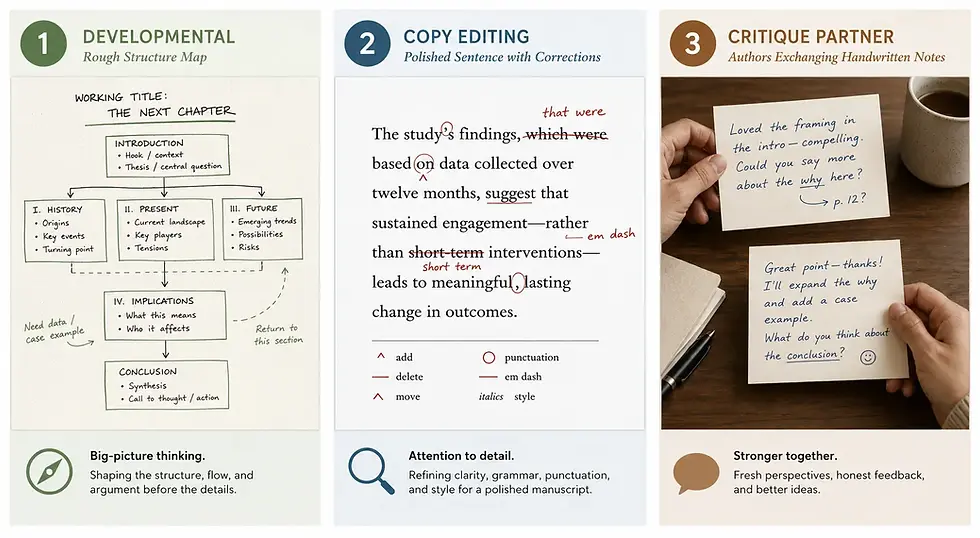
This post is a clear, practical breakdown of the differences between a developmental editor, a copy editor, and a critique partner, what each one handles, when each one belongs in your process, and how to know which one your manuscript needs right now.
The shortest version: a developmental editor works on the big picture. A copy editor works on the language. A critique partner works on both but from a reader's perspective, not a professional editor's. The longer version follows, and it is the one that will actually help you make the right call for your book.
For a broader view of how the entire editing pipeline for nonfiction authors is structured from first draft to publication-ready manuscript, Reedsy's complete editing guide provides a well-organized visual overview. This post focuses specifically on the three roles most authors encounter first and most often confuse.

What Does a Developmental Editor Handle?
A developmental editor works at the level of your book's overall structure, argument, organization, and effectiveness as a piece of writing. This is the earliest and most comprehensive professional editing stage, and it is the one that addresses the questions your manuscript must answer before any other editing makes sense.
For a nonfiction book, a developmental editor is evaluating: whether your central argument or premise is clear and consistently supported across chapters, whether your chapters are in the right order and build on each other logically, whether any sections are underdeveloped, redundant, or off-theme, whether your voice and tone are appropriate for your target reader, and whether the book as a whole delivers on the promise of its title and introduction.
A developmental edit does not fix grammar. It does not correct punctuation. It does not improve individual sentences. It evaluates the manuscript at the level where those things are irrelevant until the structural questions are answered first.
Jane Friedman's comprehensive guide to finding and working with an editor describes developmental editing as a sustained, collaborative partnership in which an editor is present in the writing process to help an author move from a draft toward a complete and cohesive book. The intellectual property always belongs to the author. The developmental editor's job is to diagnose what is not yet working and help the author see how to fix it.
The deliverables from a developmental edit typically include a detailed editorial letter covering the manuscript's big-picture strengths and structural concerns, and an annotated copy of the manuscript with chapter-level margin notes. For the full breakdown of what developmental editing services actually cover and what distinguishes a quality edit from a surface-level review, that post covers the territory in full.
The developmental edit is also the most expensive editing stage because it is the most time-intensive and requires the deepest editorial expertise. For current cost benchmarks, the post on the cost of a developmental edit in 2026 has the complete pricing picture.
When you need a developmental editor: Your manuscript is complete or near-complete. You sense something is not working but cannot identify what. Your chapters feel disconnected. You have received beta reader feedback that something is off but no one can name it. You are a first-time nonfiction author and want professional confirmation that your structure holds before moving to later editing stages.
What is the difference between a developmental editor and a copy editor?
A developmental editor focuses on the big picture: structure, argument, pacing, organization, and whether the book delivers on its purpose. A copy editor focuses on the technical layer: grammar, punctuation, spelling, consistency, and sentence-level clarity.
Developmental editing happens first, on a complete or near-complete draft, and typically results in significant revision. Copy editing happens after the structure is settled and the content is finalized. Paying for copy editing before developmental issues are resolved is a common and expensive mistake, because a manuscript that requires major structural revision will need to be copy edited again after those revisions are made.
Where Does Copy Editing and Proofreading Fit In?
Once the developmental stage is complete and your manuscript's structure is stable, copy editing is the next professional stage. This is where a skilled editor moves through your manuscript sentence by sentence and paragraph by paragraph, evaluating not the structure or argument but the language itself.
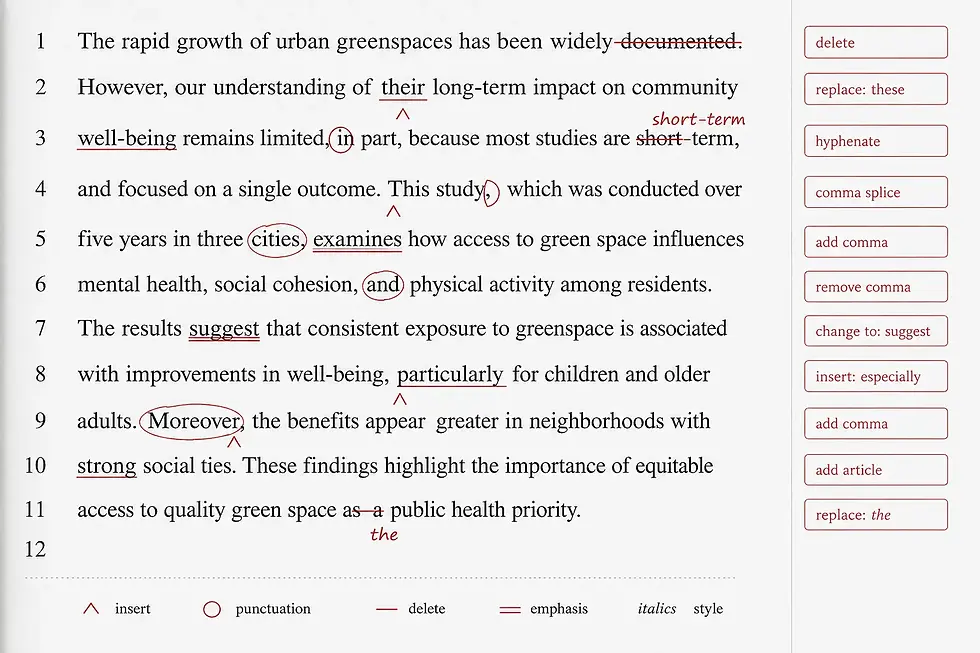
According to the EFA's editorial service definitions, copy editing addresses grammar, usage, punctuation, and spelling, as well as consistency in style, capitalization, hyphenation, and terminology across the entire manuscript. A copy editor will standardize whether you use Oxford commas or not, confirm that a person's name is spelled consistently throughout the book, flag ambiguous sentences that could confuse a reader, and ensure your manuscript follows a recognized style guide, typically the Chicago Manual of Style for books.
What copy editing does not do is address structural problems. If your chapter three is poorly organized or your central argument is never clearly stated, a copy editor will not fix this.
They will correct the grammar in a poorly organized chapter, which is why developmental editing must always come before copy editing, not after.
The third stage, proofreading, is lighter still: a final check for any errors that survived the copy edit, typically performed on a near-final formatted version of the manuscript. Proofreading is not a substitute for copy editing. It is the last safety net, not the primary technical review.
For a detailed breakdown of each of these stages with specific examples of what each catches and what each misses, the manuscript editing types post covers all four stages in plain language.
Some authors also encounter the term line editing, which sits between developmental editing and copy editing. A line editor focuses on sentence flow, clarity, and style rather than structure or mechanics. Some editors offer line editing as a distinct service. Others fold it into developmental editing or copy editing depending on the manuscript's needs. When you are evaluating a potential editor, ask them directly where their service sits on this spectrum.
When you need a copy editor: Your manuscript's structure is settled. The content is final. You have completed your own revision passes and addressed any structural feedback you received at an earlier stage. You are preparing for publication and need a professional technical review before the manuscript goes to a formatter or printer.
Does copy editing come before or after developmental editing?
Copy editing always comes after developmental editing. This order is non-negotiable in professional publishing. The reason is straightforward: developmental editing often results in significant revision, including restructured chapters, cut sections, and new content. A copy edit performed before those revisions are made would need to be redone on the revised manuscript, which means paying for it twice. The correct sequence is: developmental editing, then author revision, then copy editing, then proofreading. Some shorter or simpler manuscripts may be able to skip developmental editing if the structure is already strong, but they should never begin with copy editing.
Free Alternatives: Critique Partners vs. Premium Editors
Before committing to professional editing at any stage, many authors work with critique partners, other writers who exchange manuscripts and provide feedback on each other's work. Understanding what critique partners can and cannot offer helps you use that resource well and recognize when you have moved past what it can give you.
What a Critique Partner Can Do Well
A critique partner reads your manuscript from a writer's perspective. They can tell you when something is not working from a reader's experience: when a chapter is confusing, when a transition feels abrupt, when a particular section lost their interest, or when an argument does not feel fully supported. This is genuine and valuable feedback, particularly during early drafting when the goal is to identify obvious problems before investing in professional editing.
A strong critique partner with experience in your genre can also catch structural issues that you are too close to the manuscript to see. Writing communities, genre-specific groups, and critique partner matching services provide access to thoughtful, experienced writers who take this exchange seriously.

Where Critique Partners Fall Short
A critique partner is a reader who also writes. They are not trained editorial professionals, and the depth of diagnosis they can provide is different from what a developmental editor offers. A critique partner can tell you that chapter seven does not work. A developmental editor can tell you precisely why it does not work, what structural function it is failing to perform, and give you a specific and tested approach for fixing it.
This distinction matters practically. If beta reader and critique partner feedback on your manuscript is consistently telling you that something is off but nobody can tell you what, that is a signal that you have moved past what peer feedback can solve. A professional developmental editor is trained to diagnose exactly the problems that thoughtful readers can feel but cannot name.
The other limitation of critique partnerships is the reliability of the feedback. Beta readers and critique partners bring their own genre preferences, writing biases, and areas of expertise. Their feedback reflects their individual taste and experience rather than publishing standards for your genre and audience. This does not make their input less useful. It means you interpret it differently than you would interpret professional editorial feedback.
Jane Friedman's detailed article on what to know before hiring a developmental editor addresses the beta reader and critique partner question directly: both are valuable, but neither substitutes for professional developmental editing when a manuscript has structural issues that peer feedback cannot resolve.
For a full ROI analysis of whether professional editing justifies the investment at your specific stage, the post on whether a developmental editor is worth the investment walks through the decision framework with current cost data.
Not sure where your manuscript falls in the editing pipeline? Book a free consultation and we will look at your draft together, assess what stage it is genuinely at, and give you a clear recommendation on what your next editorial step should be. Book a Free Consultation
A Quick Reference: Which Editorial Service Fits Your Current Phase?
Where you are now | What you likely need |
Still drafting, stuck on structure | Writing coach with chapter-level feedback |
First or second draft, unsure if it works | Developmental editor or editorial assessment |
Structure confirmed, content final | Copy editor |
Copy edited, preparing to publish | Proofreader |
Early draft, want peer perspective | Critique partner or beta readers |
Experienced author with strong track record | May be able to move directly to copy editing |
This table is a starting point, not a prescription. Every manuscript is different, and the right next step depends on factors specific to your book and your writing history. When in doubt, a consultation with an editorial professional gives you a more reliable answer than a general checklist.
How Holly Approaches the Editing Pipeline at Writely Notable
The confusion between these three roles, developmental editor, copy editor, and critique partner, is something I address with nearly every author I work with, because the most common editorial mistake I see is authors investing in the wrong stage at the wrong time.
At Writely Notable, the editing services are designed for nonfiction specifically: memoirs, business books, self-help titles, and collaborative projects. The first conversation is always about where the manuscript actually is in the pipeline, not where the author hopes it is. An honest assessment of the manuscript's current stage determines which editorial investment makes the most sense.
For authors still in the drafting phase, the writing coaching packages are built so that developmental feedback happens chapter by chapter as you write, which eliminates the need for a standalone developmental edit once the draft is complete. Authors who have a finished draft that has already been through developmental review are typically ready for copy editing and proofreading before publication.
Neither path skips essential stages. They serve different starting points.
Developmental Editor vs. Copy Editor vs. Critique Partner: Which Do You Actually Need Questions Answered
Can a developmental editor also do copy editing?
Some editors offer both services, but not always in the same engagement. A developmental edit and a copy edit require different skills, different reading approaches, and different objectives. Many professional editors specialize in one stage or the other. If an editor offers both, ask how they separate the two passes in practice. Performing both at the same time is generally less effective than addressing developmental issues first, allowing the author to revise, and then copy editing the revised manuscript as a separate stage.
Should I use a critique partner before or instead of a developmental editor?
Before, not instead of, if your manuscript has structural problems. Critique partners and beta readers are most valuable during early drafting, when the goal is to identify obvious problems cheaply and quickly. After incorporating that feedback, a developmental editor provides the professional depth of analysis that peer review cannot replicate. For authors whose critique partners confirm the structure is working and the book is delivering on its purpose, it may be possible to move directly to copy editing and skip a standalone developmental edit.
Is line editing the same as copy editing?
Line editing and copy editing are related but distinct. Line editing focuses on style, rhythm, clarity, and the quality of prose at the sentence level. Copy editing focuses on technical correctness: grammar, punctuation, spelling, consistency, and adherence to a style guide. In practice, many editors combine them or use the terms interchangeably, particularly for nonfiction. When evaluating an editor, ask them to describe specifically what their copy edit or line edit covers rather than relying on the label alone.
What if I cannot afford all three stages of editing?
If budget requires prioritizing, developmental editing should come first for any author whose manuscript has structural uncertainty. A book with structural problems and polished prose is still a book with structural problems. The reverse is not equally true: a structurally sound manuscript with imperfect prose can still communicate effectively and receive a positive reader response. If you must choose between stages, invest first in the stage that addresses the deepest layer of your manuscript's current needs.
Conclusion: Developmental Editor vs. Copy Editor vs. Critique Partner: Which Do You Actually Need?
The distinction between a developmental editor, a copy editor, and a critique partner is not a semantic debate. It is a practical question about where your manuscript is right now and what it needs next. Getting this wrong costs time and money. Getting it right means every editorial investment you make is applied to the correct layer of your manuscript at the correct stage.
Use this as your decision framework: if your book's structure and argument are uncertain, start with developmental editing or coaching. If your structure is confirmed and your content is final, move to copy editing. If you are early in drafting and want reader perspective without professional cost, a critique partner is the right tool. And if you are not sure which category your manuscript falls into, that uncertainty is itself the answer: it belongs in a professional assessment before any other investment.
Once you know which stage you need, the post on how to choose and vet a developmental editor is the next step for finding the right professional to work with.
Ready to find out exactly which editorial stage your manuscript needs? Book a free consultation at Writely Notable and we will assess your manuscript's current stage together, giving you a clear, honest recommendation on your next step before you spend anything. Book a Free Consultation
About the Author: Holly Totten
Holly Totten is a nonfiction writing coach and editor with over 30 years of experience in English education and the founder of Writely Notable and Gathered with Purpose. She has published three collaborative books and works one-on-one with nonfiction authors, memoir writers, and entrepreneurs to take their manuscripts from first draft through to publication-ready. Connect with Holly on LinkedIn or learn more on the About page.


Comments